



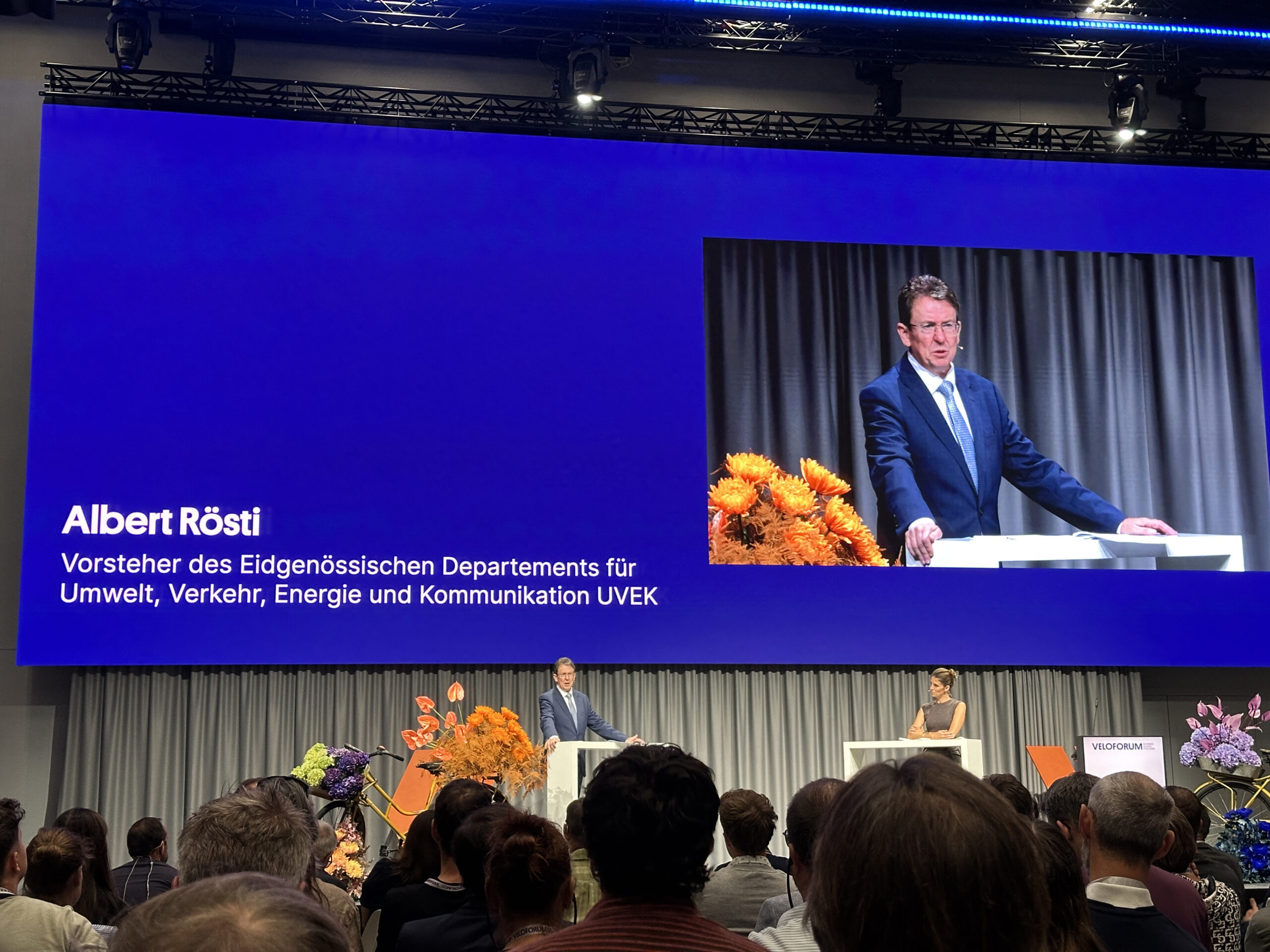
Around 240 experts from the worlds of politics, public administration, business, academia and sport gathered on Monday at the Veloforum Schweiz Suisse Svizzera in Bern to discuss the path towards a cycling revolution. Federal Councillor Albert Rösti believes Switzerland is well on the way to implementing the Cycle Route Act. Christophe Najdovski, the former deputy mayor of Paris, reported on how the «Plan Vélo» is being implemented in the French metropolis. Velosuisse acted as a partner organisation for the event and contributed the industry’s perspective to the various discussions.
Federal Councillor Albert Rösti attended the fourth edition of the National Cycling Forum in person for the first time. In his speech, the Minister for Transport described the bicycle as a «huge advantage for local transport» and as the most efficient mode of transport over short and medium distances. He reaffirmed the aim of the Cycling Roadmap to double the number of kilometres cycled by 2035. The minister called for a little more patience and, in response to critical voices from Parliament, noted that Switzerland was well on track with the implementation of the Cycle Paths Act. «Almost all cantons now have a dedicated cycling unit, and with the exception of two or three, all cantons are on track.»
During the «Velefantenrunde», Lisa Mazzone (President of the Greens), Philipp Matthias Bregy (President of Die Mitte), Jürg Grossen (President of the GLP), Benjamin Mühlemann (Co-President of the FDP), David Roth (Vice-President of the SP) and Henrique Schneider (Secretary-General of the SVP) were asked about their views on the Cycling Roadmap and the implementation of the Cycle Paths Act. With the exception of Schneider («Promoting cycling is not a priority for the SVP»), the politicians are in agreement regarding the objectives. However, when it came to the question of how these objectives should be achieved, significant differences emerged. Mazzone, Roth and Grossen believe the federal government should take on more responsibility. Bregy argues that there should be less ideology and more tax incentives. Mühlemann, on the other hand, advocates for better framework conditions rather than regulations.
Paris: From 40,000 cars to zero
Christophe Najdovski, Deputy Mayor of Paris until 2026, demonstrated what can be achieved within a few years if the political will is there. For him and Mayor Anne Hidalgo, the focus was on the redesign of public spaces. «In 90 per cent of cases, a car carries just one person. It was therefore clear to us that pedestrians, cyclists and public transport must be given more space.» The 3.3-kilometre-long expressway on the right bank of the Seine – used by over 40,000 cars every day – was turned into a pedestrian zone overnight. Use of Paris’s cycle paths increased by 166 per cent between 2016 and 2020, and by a further 47 per cent by 2025. ’It works if you want it to.«
Michael Liebi, President of the Swiss Cycling Conference, warned against excuses such as: «We’re not Paris.» Whilst this might seem obvious, he said, it is the wrong way to think. The cycling revolution has also been a success in the Netherlands, Denmark, Strasbourg and Freiburg im Breisgau. The Cycle Paths Act has laid the foundations. What is needed now is proper planning: «If we treat cycling as a niche, we’ll end up with niche solutions. If we think big about cycling, we’ll end up with more people-friendly towns and cities.»
Matthias Aebischer, Director of Transport for the City of Bern, announced plans to give the federal capital’s cycling infrastructure – which is already good by Swiss standards – a red makeover. He also intends to remove a car lane at the Bollwerk, as has already been done on the Lorrainebrücke, to make way for cycle traffic.
Greater safety is the aim of the ‘Velowende’ initiative
Stefan Siegrist, Director of the Swiss Council for Accident Prevention (bfu), presented the latest accident figures: In 2025, 1,257 cyclists and e-bike riders were seriously injured in Switzerland, and 44 died – with the trend for e-bikes on the rise. Ursula Wyss, former Head of Transport for the City of Bern and now an urban planning consultant, called for a «forgiving» cycling infrastructure. The infrastructure and transport system must be designed in such a way that cyclists aged between 8 and 80 can travel safely and remain unharmed even if they make a mistake. “If the general speed on the road exceeds 30 km/h, cycle lanes should be separated from motorised traffic.”
The panel, comprising Evi Allemann (Member of the Cantonal Government of Bern), Christian Bättig (Vice-President of Velosuisse), Lorenzo Cascioni (Deputy Director of ASTRA), Dimitri Marincek (University of Lausanne), Nils Planzer (CEO of Planzer), Siegrist and Wyss, the discussion centred on how accident figures could be reduced. The range of proposed solutions extended from better training for road users through to technological advances, infrastructural adjustments, speed limits, a mandatory minimum lateral distance of 1.5 metres between cars and bicycles – as is already mandatory in neighbouring countries – to a possible compulsory helmet law.
The figures – or rather, the way they are collected – were also a topic of discussion, as accident reports from the various police forces in Switzerland are not standardised. Bättig therefore described the figures as «gorillas in the fog». However, the reports are soon to be brought up to date, and trend vehicles such as e-scooters will also be recorded separately.
Inclusion is not taken for granted
At the inclusion panel discussion, Heidi Hanselmann, Chair of the Board of Trustees of the Swiss Paraplegic Foundation, and two-time Paralympic gold medallist Manuela Schär highlighted the limitations faced by people with spinal cord injuries on cycle paths. Schär said that, whilst riding her handbike, she often encounters situations where she comes up against obstacles that are almost impossible, or even completely impossible, to overcome. Hanselmann identified an overarching problem here. «Inclusion hasn’t yet taken root in people’s minds and isn’t regarded as a matter of course,» she noted, calling on politicians to always carry out an inclusion impact assessment when developing cycling infrastructure.
During three breakout sessions in the afternoon, discussions centred on coexistence on cycle paths, tax incentives and company bicycles, as well as the reasons for the long journey from planning to implementation of the Cycle Paths Act. The event concluded with an inclusive cycling dance show.
A positive outcome, but there is still a lot to be done
No shortcut to turning the tide for cycling was found at the Swiss Cycling Forum. Switzerland is still some way off its target of doubling the number of kilometres cycled. Nevertheless, the hosts« conclusion is a positive one. »The lively debates have shown how important regular dialogue and networking between stakeholder groups is,« said Flavia Wasserfallen, co-president of the Swiss Bike Park Foundation. Swiss Cycling President Luana Bergamin noted that such dialogue helps people to understand others» perspectives and gradually find common ground, so that the enormous potential of cycling in Switzerland can be better utilised. Both figures agree that pressure must be maintained on politicians: “Almost 74 per cent of Swiss voters said ‘yes’ to the Cycle Paths Act. This is a clear signal that obliges us as a society to significantly improve the infrastructure nationwide – as stipulated in the text of the Act.”
15 September 2026